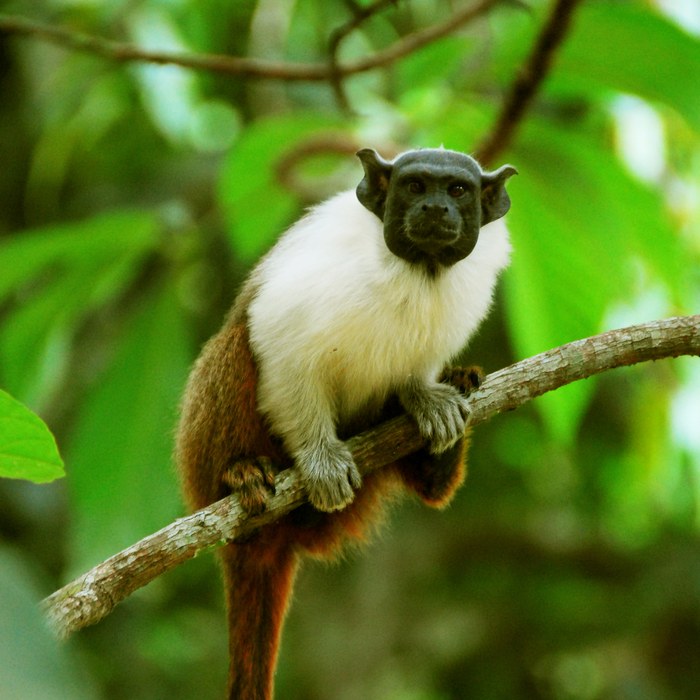
We are delighted to share our recent paper, “Noise, resources, and social factors shape space use and movement patterns in a small Amazonian primate”, out Open Access in Urban Ecosystems and led by Tainara Sobroza.
Noise can mask sounds and disrupt animal behaviour, and many species respond by avoiding the noisiest parts of their ranges. But how do primates living in cities cope? We followed nine groups of pied tamarins (Saguinus bicolor) in five forest fragments within the city of Manaus, Brazil, recording their locations alongside ambient noise levels and estimating fruit availability across their home ranges.
We found that the tamarins used the quieter areas of their ranges more intensively, but only where fruit availability was high. Groups did not speed up or change direction in response to noise alone, but they did travel faster through noisier areas closer to the borders of their home ranges, possibly because higher noise levels there could make communication between groups less effective.
Together, these results show that pied tamarins’ use of space and movement patterns are shaped by the soundscape, but mediated by resource availability and social factors.
Huge thanks to Tainara and our coauthors Marcelo Gordo, Bruna Mendel Naissinger, Luciano Querido and Adrian Barnett!
Sobroza TV, Gordo M, Dunn JC, Naissinger BM, Querido L, Barnett AA (2026). Noise, resources, and social factors shape space use and movement patterns in a small Amazonian primate. Urban Ecosystems 29: 57. https://doi.org/10.1007/s11252-025-01897-y