A huge congratulations to David Reby on his recent ERC Synergy Grant, €6.8 million over six years! David shares the award with Olivier Pascalis (CNRS, Grenoble) and Julia Simner (University of Sussex). Their project, ViSONIC, aims to turn everyday sounds into images that people can understand without training, to make sound accessible to deaf and hard-of-hearing people. It is a tremendous achievement and I can’t wait to see what comes of it.
David and I go back a long way: he was a co-author on our 2015 Current Biology paper revealing an evolutionary trade-off between vocal tract and testes size in howler monkeys. More recently, our collaboration on how animals produce and perceive sound has led to our paper showing that howler monkey roars are reliable signals of body size (Animal Behaviour, 2026). It has also led to a forthcoming study on how sika deer produce their high-frequency “whistles” (Journal of Experimental Biology, in press).
Since 2024 I have also been a Visiting Professor at David’s lab, the ENES Bioacoustics Research Laboratory (Équipe de Neuro-Éthologie Sensorielle) at Jean Monnet University, Saint-Étienne, one of Europe’s leading groups working on animal acoustic communication. My links with the lab go back to 2023, when I spoke at the ENES symposium on nonlinear phenomena in vertebrate vocalisations, presenting our work on the comparative anatomy of the primate larynx.
The visiting post also connects me with ENES’s International Master of Bioacoustics (MoBi). This year I am supervising an MSc student on a project on hyoid anatomy, and it is a pleasure to bring students into our comparative anatomy work.
Many thanks to David, Nicolas Mathevon and everyone at ENES for such a warm welcome. I look forward to many more collaborations between Saint-Étienne and Cambridge.
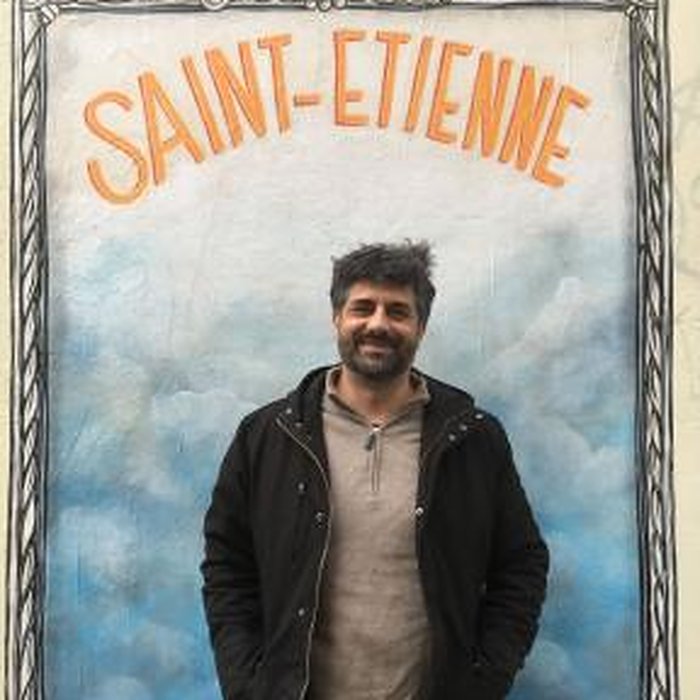
Pictured: David Reby in Saint-Étienne.
Dunn JC, Halenar LB, Davies TG, Cristóbal-Azkarate J, Reby D, Sykes D, Dengg S, Fitch WT, Knapp LA (2015). Evolutionary trade-off between vocal tract and testes dimensions in howler monkeys. Current Biology 25(21): 2839–2844. https://doi.org/10.1016/j.cub.2015.09.029